A very reasonable question for parents today is: “AI can write code Okay, why does my child still have to learn programming?" If the goal is just to turn your child into someone who can type commands faster than a computer, the answer is probably not necessary. But that is never the best goal of learning programming for children.
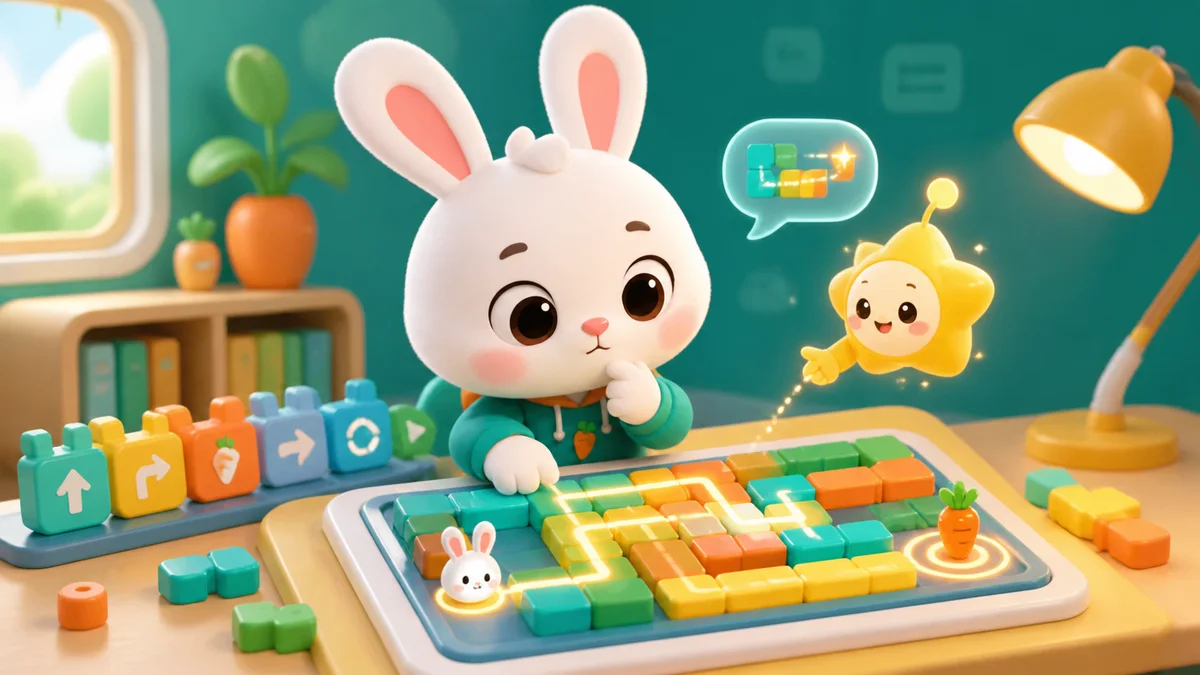
For children, programming is a gym for thinking. A bunny needs to go to the carrot; The road is rocky, has turns, and the number of command blocks is limited. To solve, children must observe, predict, try, recognize mistakes and then correct them. The "code" is just the child's way of expressing his thoughts clearly so that the machine can follow.
AI gives the answer, but the child still has to know how to pose the problem
AI is very good at creating solutions when receiving clear requests. But in real life, problems often don't come in the form of complete questions. Children need to learn to recognize: what they want to achieve, what they already know, what data is missing and what constraints there are.
When programming, children practice that same chain of thinking. “Bring the rabbit to the destination” must be translated into: how many steps to take, where to turn, what to do when encountering an obstacle, what action is being repeated. If a child does not know how to separate a big desire into small tasks, it will be difficult for children to assign tasks to AI and evaluate the answers given by AI.
The important ability in the AI era is not to do everything without AI. It is knowing what problem you are solving, using AI at the right time and still retaining the right to check the results.
Four thinking habits children get from programming
1. Break the problem down
A long maze can confuse your baby. But he can handle the straight ahead first, then the turn, then look at the rest. This habit is also useful when your child is doing multi-step math problems, preparing a backpack or doing a project at school.
2. Anticipate before acting
Instead of randomly pulling and then pressing run, the baby gradually learns to say: "I think the rabbit will go three spaces and stop in front of the stone." A prediction creates a hypothesis; The results on the screen give your baby evidence to confirm or change that hypothesis.
3. View errors as information
In programming, wrong does not mean bad. Errors show where thinking and actual results are different. When given enough hints instead of giving the answer, the baby learns to calmly observe and try again.
4. Find many solutions
A problem can be solved with eight command blocks, then the child discovers that using a loop only requires four blocks. Both reach their destination, but the latter solution is more concise. Your baby begins to understand that being “right” is the first step; Then it can be clearer, shorter or more flexible.
AI should be a guide, not a doer
AI can be very useful as a friend asking back: “What step is the rabbit stuck on?”, “Are there any repeated instructions?” or “What do you predict will happen if the number 3 is changed to the number 4?” These questions keep the child in the thinker position.
On the contrary, if the AI immediately gives all the answers, the experience seems to flow smoothly but the thinking training part disappears. A simple rule is: step-by-step suggestion. First remind the child to observe, next point out the problem area, and finally illustrate a small step if the child is still stuck.
So does the child need to become a programmer?
No. Just like learning math doesn't mean every child has to become a mathematician. In the future, your child can work in design, medicine, science, business or art. The ability to clearly describe problems, reason sequentially, verify information, and collaborate with digital tools are all still useful.
Things to remember
In the age of AI, the value of learning to program shifts from “typing every line of code by hand” to “knowing how to think structured.” Let AI assist at the right time, but the right to observe, choose and correct mistakes still belongs to the child.
Let the child try a small math problem
Let the child arrange the path for the Cotton Rabbit. When wrong, Karotto suggests each step instead of giving the answer right away.
Try the drag-and-drop game →