
Each year, when the announcement of the TIMO exam appears in parent group, many parents wonder: What is TIMO, is it reputable, what grade can my child take the exam, how difficult is the test and should I let my child practice?
This article summarizes things that have been verified from public announcements, and directly states the points that parents need to re-check for themselves every year. We also share a math teacher's perspective on the benefits and risks of giving your child the test.
What is TIMO?
TIMO stands for Thailand International Mathematical Olympiad, roughly translated "Thailand International Mathematics Olympiad". According to information announced by the organizers, the exam is organized annually by the Hong Kong Olympiad Champion Education CenterHong Kong Olympiad Champion Education Center in coordination with Thailand, and has students from many countries participating. In each country there is usually a partner unit that organizes domestic rounds; In Vietnam, announcements of recent seasons have been issued by domestic partners.
Parents should understand clearly: TIMO is an exam organized by a private educational organization and for a fee, not an exam organized by the Ministry of Education and Training, nor an International Mathematics Olympiad (IMO) for high school students. That doesn't mean the exam is not valuable, but parents should consider this a playground for their children to try, and thoroughly research the organizer before registering.
What grade is TIMO for?
According to the announcement in Vietnam for the 2024-2025 season, the candidates for the exam are students from kindergarten to grade 12. Each grade level has its own topic; Grades 10, 11, and 12 take the same topic and consider the same solution. For elementary school, parents are often most interested in grade 1, 2, and 3 topics.
TIMO topic structure: 5 areas of knowledge
This is the most characteristic feature of TIMO. The test is divided evenly into 5 areas, so children cannot just be good at calculating and get high scores:
- Logical thinking: reasoning puzzles, lining up, who stands where, who tells the truth. For example: "Frog is a boy, has 3 younger sisters and 2 younger brothers. How many children do Frog's parents have?" The answer is 6, because you have to count the frogs: 1 + 3 + 2 = 6. The trap is forgetting the character mentioned.
- Arithmetic (older grades have algebra): quick calculations, age problems, word problems. For example, quickly calculate 2 − 3 + 4 − 5 + 6 by combining (−3 + 4) and (−5 + 6), each pair equals 1, to get 2 + 1 + 1 = 4.
- Number theory: digits, parity, and divisibility. For example, how many two-digit numbers are there where the units digit is greater than 4? Tens has 9 ways (1 to 9), units has 5 ways (5 to 9), so there are 9 × 5 = 45 numbers.
- Geometry: simple counting, jigsaw puzzles, perimeter, area. For example: a triangle with two straight segments drawn from top to bottom has 6 triangles (3 small triangles, 2 triangles made from 2 adjacent parts, 1 large triangle). For example: there are 3 shirts and 2 pants, there are 3 × 2 = 6 ways to choose a set of clothes.
- Combination:count how to choose, how to arrange. For example, if there are 3 shirts and 2 pants, there are 3 × 2 = 6 ways to choose a set of clothes.
Competition rounds and exam format
According to the announcement in Vietnam for the 2024–2025 season, TIMO has three rounds:
Information published in other regions (Canada, Philippines, Hong Kong...) also describes a test of 25 questions divided equally into 5 areas in the first round, and students who win medals are invited to the final round. However, the number of questions, time, language and test format may vary between years and countries. Parents, please see the official announcement of the current year's organizers before making plans.
About English: the following rounds will be in English. For children in grades 1–3, the big barrier is often not math but reading comprehension. If you plan to let your child continue, you should gradually familiarize them with familiar words in math problems (how many, more than, total, pattern...).
How to register for TIMO exam in Vietnam?
Notice recent seasons allow two ways: individual registration via online link, or registration by application position (school, center prepares a list to send to the organizing committee). Each round has its own fee; If you take the exam abroad in the international round, your family will have to pay for additional travel and accommodation costs.
Because the exam schedule, fees and registration methods change each year, we do not write specific numbers here. A few things to do before paying:
- Read the latest official announcement, compare the names of the domestic organization and the international organization.
- Ask clearly about the total cost for all subsequent rounds, not just the first round fee.
- Only transfer according to the information stated on the official notice, keep the receipt accept.
- Ask your child's school to see if they register by unit; Sometimes this way is simpler.
Benefits of giving your child the TIMO test
- Having specific goals: For children who like to solve puzzles, an exam helps practice have a destination.
- Exposure to all 5 areas: Classroom programs rarely have combinations or logic, TIMO questions force children to learn more balanced.
- Get used to time pressure: 25 questions in 60–90 minutes teach children to skip difficult questions and come back later.
- Experience the room Exams: Online supervised exams or centralized exams are both new experiences.
Risks: pressure and poor learning
From the perspective of elementary school math teachers, there are three risks that parents should pay attention to:
Achievement pressure
Medals are attractive rewards for both parents. But 6–8 year old children are very sensitive to adults' expectations. If after each practice session your child gets angry, cries, or says "I'm bad at math", that's a signal to reduce the load or stop.
Studying in the form
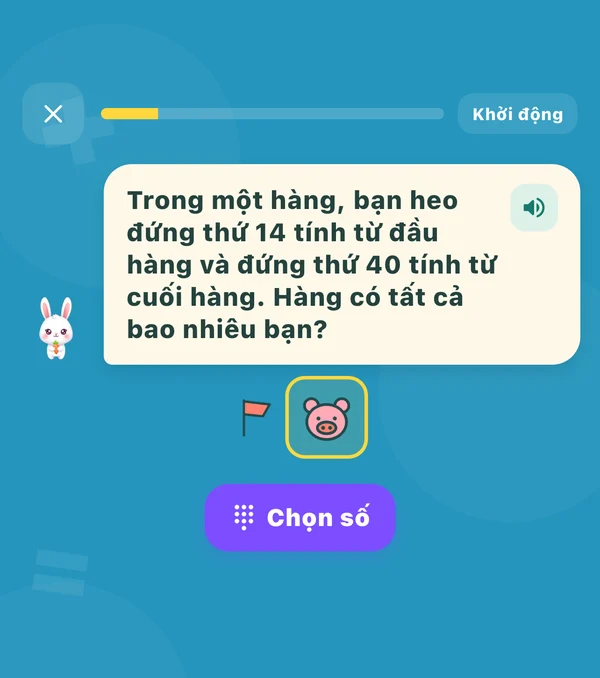
There are training courses that teach tricks like "if you encounter a problem with a beginning and an end, add and subtract 1". The child does the familiar task correctly, but changing one word in the question is confusing. Simple way to check: ask your child to explain in wordsexplain in words why 1 is subtracted. If the child can say "because the pig was counted twice", the child understands; If your child just says "I said so", he or she is learning.
Differing from the foundation
Spending too much time on exam questions can cause your child to neglect basic calculations in class. Mental arithmetic is probably what helps your child complete the test faster.
Should your child practice TIMO?
Our advice: yes, if your child likes solving puzzles and wants to try it himself; Don't force your child if he or she is not excited. A reasonable practice rhythm for elementary school children is 15–20 minutes a day, alternating sections, and each week doing a short problem with time to get used to it. More important than the score is that after each test, sit with your child to review the wrong answers and ask them what they thought.
If you want to know where your child is at, parents can let your child try practice questions with solutions: TIMO-style practice questions grade 1, grade 2 and grade 3. Common types of math problems are explained in the article Common types of mental math in elementary schools, and the general picture of mental math is in mental math handbook for children.
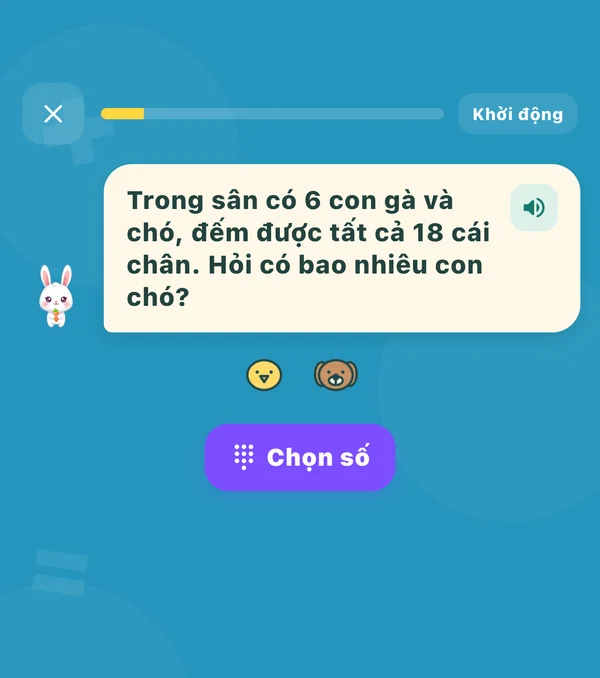
TIMO style practice in Karotto app
Transparency note: Karotto is an app developed by the team behind this website. Karotto is not affiliated with the TIMO organizing committee or any other exam organizer. The practice questions in the app are autogenerated questions following similar sections, not real exam questions.
In the Math course "Garden of Numbers" (504 lessons, 8 islands M1–M8), alternating between stages is usually a TIMO style training in 5 areas: logic, arithmetic, number theory, geometry, combinatorics. Grade 0 (kindergarten) is located on the 5-year-old island, grades 1, 2, 3 are on islands M4, M6, M8. At the end of the island, there is Practice questions in exam format: with a clock, scored in each area so parents can see where their children are strong and weak, and let them review wrong sentences.
Each question has a Vietnamese voice (the app supports 13 languages), 3-level suggestions (gentle reminders, illustrations, answers with explanations), no advertising. Every day your child learns a reasonable amount of lessons for free; Premium unlimited learning, buy once for lifetime use, no subscription required.
In short
TIMO is a paid international math exam, divided equally into 5 areas of logic, arithmetic, number theory, geometry and combinatorics. It can be a good playground for children who like to solve puzzles, as long as they understand the lessons and don't just learn them, and parents always check the current year's official announcement before registering.
Frequently Asked Questions
What does TIMO stand for?
TIMO stands for Thailand International Mathematical Olympiad, Roughly translated as Thailand International Mathematics Olympiad. According to information announced by the organizers, the exam is organized annually by the Hong Kong Olympiad Champion Education Center, in collaboration with Thailand.
TIMO is for which grade students?
According to the announcement in Vietnam for the 2024-2025 season, the exam is for students from kindergarten to grade 12, each grade level has its own topic. (grades 10, 11, 12 do the same topic). Parents should check the official announcement for the current year because the regulations may change.
What parts does the TIMO exam include?
The exam is divided equally into 5 areas: logical thinking, arithmetic (or algebra), number theory, geometry and combinatorics. According to the 2024–2025 season announcement, the qualifying round and national round have 25 questions, 5 questions each; The international round has 30 questions, 6 questions each.
How to register for TIMO exam in Vietnam?
In recent years, announcements in Vietnam allow individual registration via online link or registration by school or unit. Schedules, fees and registration methods change each year, so parents need to read the latest announcement from the organizer and check carefully before paying the fee.
Are the TIMO practice questions in the Karotto app real exam questions?
No. Karotto is not affiliated with TIMO organizers. The practice questions in the app are automatically generated by the app in 5 similar areas (logic, arithmetic, number theory, geometry, combinatorics), and do not copy real exam questions. The goal is to help children get familiar with the types of exercises and the timed rhythm of doing exercises.
Practice the 5 areas of mental math with Thỏ Bông
Train the 5 areas of self-generation, with time, marking according to the array, reviewing incorrect sentences, and having a Vietnamese voice. Every day, learn a reasonable amount of lessons for free.