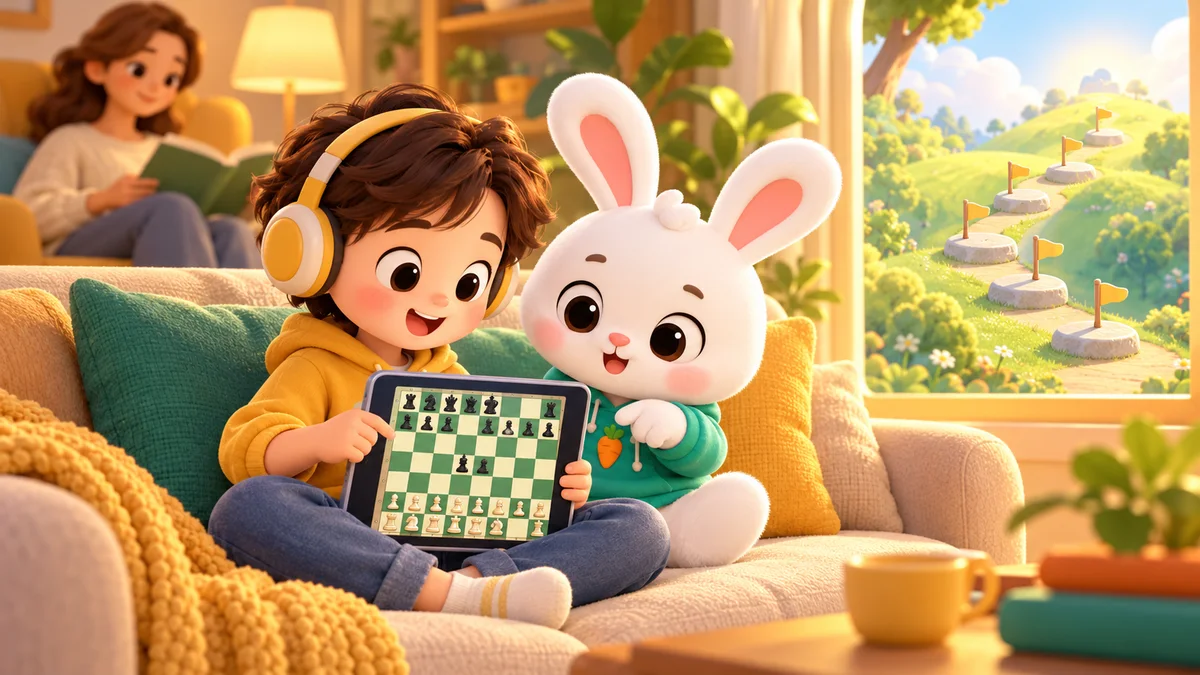
Many parents want to teach I learn chess but I'm embarrassed because I don't know how to play, or I only vaguely remember how the pieces move. The good news is that in the early stages, what children need most is not a good chess teacher but a reasonable learning orderReasonable learning order: what to learn first, what to learn next, and when to be strong enough to move on to the next step.
This article divides learning chess at home into 6 stages. Each stage has three parts: what your baby learns, signs that your baby has mastered it, and an estimated time. Time is for reference only; Each child has a rhythm, and slow and steady is always better than fast but empty.
Before starting: is your child ready?
Children do not need to know how to read or do mental arithmetic well. Just need your baby to be able to sit still for about 10 minutes for a game, be able to distinguish between left and right, and accept losing a game without being too sad. Most children achieve these things around 5–6 years old, some children achieve them earlier. If you are still concerned about age, parents can read the article What age should a child learn chess?
Minimum preparation: a real chess set (big, easy-to-hold pieces), a fixed seat, and a familiar time every day, for example after dinner.
6-step itinerary learn chess at home
The roadmap below follows the spirit of "step by step": each step only adds a few new ideas, and new ideas always build on what the child already knows. This is also the way many chess clubs for children in Europe still use.
Stage 1: Get familiar with the chess board and the rules of the game
What children learn: names of squares on the chess board, how to arrange pieces, how each piece moves and eats. Next is to protect your piece, take a safe piece, take a "profit" piece (exchange a small piece for a large piece), check and escape check, checkmate. At the end of the stage are the special rules: castling, promotion, en passant, stalemate, and how to record the moves.
Signs of stability: the child arranges the chessboard correctly (the back stands on the same color box), no longer goes against the rules in a game, recognizes when he is being beaten check, and checkmate gets the opponent's king in simple positions like the checkmate rook in the last row.
How long does it take: this is the longest stage in terms of amount of knowledge. Learning regularly every day, many babies need about 2–4 months. Young children may take longer, which is completely normal.
Parents who need to review the rules with their children can see Guide to playing chess for children and Tam, checkmate and special rules.
Stage 2: The first tactical moves
What the child learns: double attack (one piece threatens two pieces at the same time, for example the knight "takes a pair"), pinning (the opponent's piece does not dare to move because it will reveal a more valuable piece behind it), intervening move to block check, checkmate in 2 moves, and principles Basic opening: bring out the pieces early, compete for the center, castling to keep the king safe.
Signs of stability: the child begins to find his own double attack in real games, not just in exercises. The child rarely lets his pieces be taken for free, and in each game he shows his knight and bishop before running around in the rear.
How long does it take: usually 2–3 months.
Stage 3: Combination attacks and good endgames
The child learns what: open check (a piece moves out to reveal the check of the piece behind), double check, through ray (hits the piece in front to take the piece behind). In parallel, there is a good endgame and the "pawn's square" rule to know whether the king can catch up with the pawn or not.
Signs of stability: the child can see the two-step move (move one piece to open the way for the other) and be confident when the game only has the king and a few pawns, instead of asking for a draw because "out of pieces".
How long does it take: about 2–4 months.
Stage 4: Think many moves ahead
What the child learns: lure troops (sacrifice to pull the opponent's troops into unfavorable squares), destroy castles (destroy good classes) cover the king), practice thinking in advance of 3 moves "I go, you answer, I continue", and common endgame positions.
Sign of stability: before going, the child asks himself "If I go like this, how will you respond?". He dares to sacrifice soldiers when he clearly sees the benefits behind it, not at risk.
How long does it take: 3–4 months or more. From this stage, slow progress is normal.
Stage 5: Understand the chess position, not just look for attacks
What children learn: consider material (more pieces) and time (faster moves), occupy an open column for the rook, put the rook on row seven, and zugzwang (so the right side goes is disadvantageous, the price of "skipping a turn" is better).
Signs of stability: when there are no attacks, the child still knows what to do that is useful: placing the rook in the column is not good, improving the piece that is standing poorly.
How long does it take: 3–5 months.
Stage 6: Planning for the whole game
What children learn: planning based on the chess position, distinguishing between good bishops and bad bishops (bishops blocked by their own pawns), rook endings, and draw mechanisms that help save a game The game is losing.
Signs of stability: the child can recount his game in the way "I intended to attack the king's side so I brought a luxury cart", and knows how to keep the draw when losing pieces.
How long it takes: depends on the child, usually a few months or more. By the end of this stage, your child will have a strong enough foundation to continue learning with advanced books, clubs or coaches.
A general rule: change stages when you see signs of being stable in the real game, not when you have "finished learning the lesson". If your child solves the exercise correctly but still leaves the piece empty in the game, stay at that stage for a few more weeks.
How can parents who don't know how to play chess teach their children to learn chess?
The role of parents at home is not to be a lecturer but to be a companion: keep pace, ask questions and praise in the right places.
Ask the right questions
Instead of "Are you going right?", ask questions that force your child to think:
- "Which of your pieces is being threatened?"
- "The move is just right Then what do you want to do?"
- "If you move like this, can you take any pieces?"
- "Do you have any other way?"
Parents don't need to know the answer. Just by listening to your child's explanation, he or she will discover his or her own mistakes quite often. This is also the companion method that we have suggested for programming in the article Parents who do not know programming can still accompany their children, and it applies very well to chess.
Don't go for me
When the child is confused, it is easy to point the finger "go that knight". Please try to endure. A small hint like "try looking at the horse" is much better than giving the answer. Children remember the longest what they find out for themselves.
Praise the process, not just the victory
For children 5–7 years old, praise "you checked your pieces before going". For children 8–11 years old, praise them when they review the losing game and find a bad move. Winning and losing are just results; new thinking habits are what stay.
Balancing the screen and real chessboard
Learning on an app or computer helps children practice many chess positions in a short time and get their errors corrected immediately. But real chess teaches things the screen cannot teach: sitting across from someone, waiting for your turn, shaking hands after the game and accepting defeat.
An easy-to-apply ratio:
- Weekdays: 10–15 minutes of exercises (on app or book), then stop.
- Weekend: 1–2 games on a real chess board with parents, grandparents or friends.
- After each real game: present a move that the child regrets the most and find a better move together.
If Need a specific practice schedule for each day of the week, with exercises with answers, see article Chess exercises for children: 15-minute practice schedule every day. Regarding screen time in general, the article How long should children study each day has a few more suggestions based on age.
Karotto follows this 6-stop route
Transparency first: Karotto is the app of the team behind this website. The Chess course in Karotto includes 283 lessons, divided into exactly 6 Steps like the 6 stages above, from getting familiar with the chess board in Step 1 to the lesson "Pawn karma" in Step 6.
Each lesson has a "Sample Study" section. (baby looks at sample moves with arrows) then comes the "Practice" part (baby walks on his own). When the child makes a mistake, the chessboard shows the consequences so the child can see why he or she is wrong; When you make the right move, the chessboard also shows why that move is good. If the child is stuck, the robot suggests each step step by step rather than giving the answer right away.
At the end of each Step, there is a Review lesson and a test Test of 20 questions, helping parents know whether the child is stable enough to move on to the next Step, true to the spirit of "changing stages when you are stable" in above.
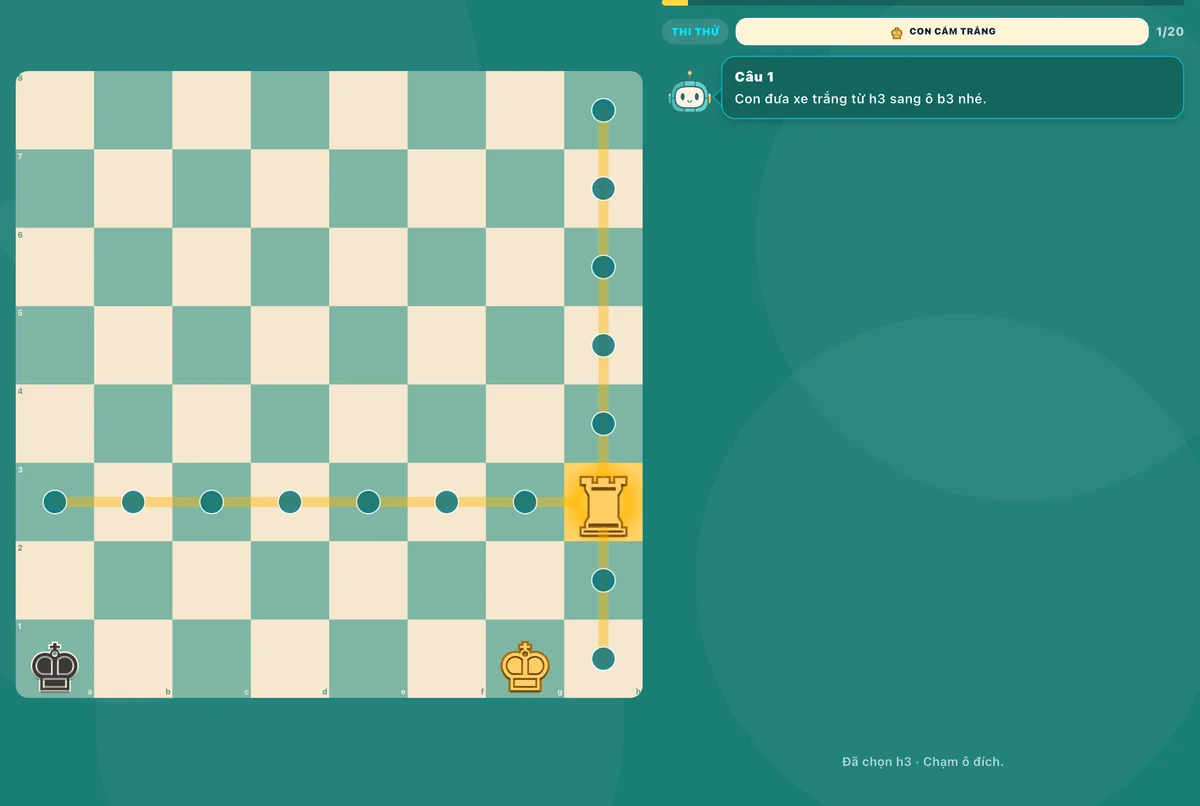
What we pay most attention to is reading voice: instructions and comments are read out loud (in Vietnamese), so children who can't read well can still learn on their own without needing parents to sit and read each sentence for them.
Every day the child reads Learn a reasonable amount of lessons for free; At the end of the turn, Thỏ Bông makes an appointment for the child tomorrow, helping to maintain a healthy learning rhythm. If you want unlimited learning, the Premium package is a one-time purchase, lifetime useBuy once, use for life, not a monthly or yearly subscription. The app has no ads.
In summary
Successful self-study of chess at home depends on three things: a roadmap from easy to difficult, a short but steady learning rhythm, and parents who know how to ask instead of doing it for them. Don't rush to change stations; Wait until what your child learns appears in his own chess game.
Frequently Asked Questions
Can parents who don't know how to play chess teach their children to learn chess?
Yes. Parents do not need to be good at chess, they just need to keep a steady rhythm, ask their children to explain their moves and learn the rules with their children. The technical part can be based on books, videos or an app with roadmaps and explanations.
How long should a child learn chess each day?
For children 5–7 years old, 10–15 minutes a day is enough. Children 8–11 years old can study for 20–30 minutes, divided into short exercises and a game of chess. Studying regularly every day is more effective than studying in one long weekend session.
How long does it take for a child to complete 6 stages?
There is no fixed number. If they study regularly, many children need a few months for the first stage and longer for the later stages. Change stages when your child shows signs of being stable, do not follow the schedule.
Can a child who is not yet fluent in reading learn chess on his own?
Yes, if the instructions are read out loud or an adult reads it with him. Chess is mainly about looking at the board, so children who can't read well can still learn well when there is a clear voice and illustrations.
Let your child start stage 1 today
Karotto has a 6-Step chess roadmap, Vietnamese voice for children who can't read well, and a one-time Premium package for lifelong use.
Get it on App Store → Get it on Google Play →