If your child has not To understand the moves of Rook, Bishop, Queen, King, Knight and Pawn, parents should start from the lesson instructions for playing chess for children first. The rules below are based on that approach.
Don't teach it all in one session. Children 6–7 years old usually need several sessions for screening and checkmate alone. Children 9–11 years old may learn faster, but castling and en passant are still two rules that even new adults often misremember.
What is chess?
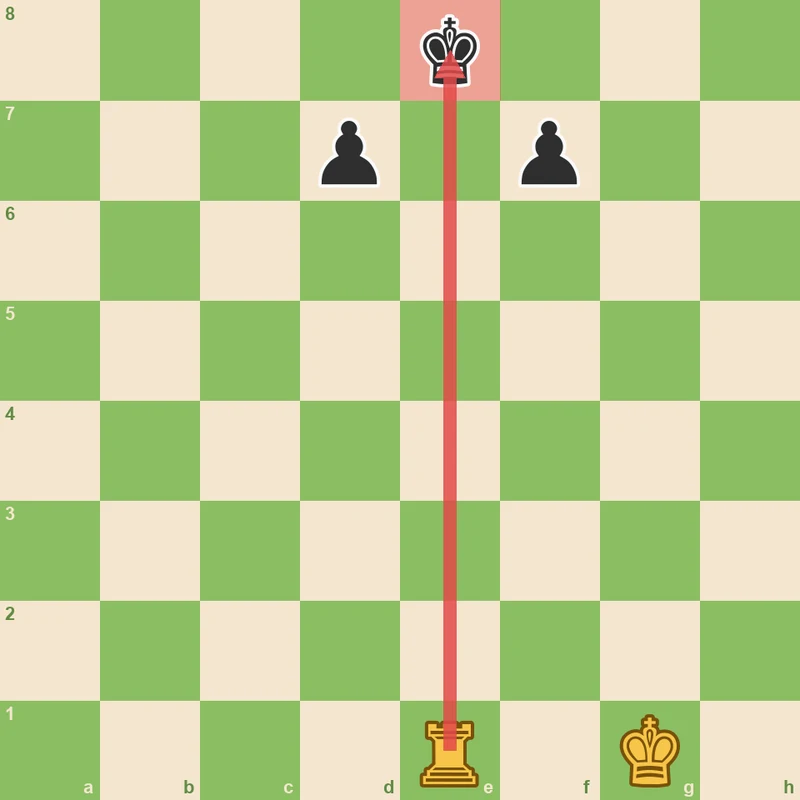
Check is when King is being attacked by an opposing piece, meaning that if it can continue, that piece will capture King. In chess, King is never actually captured: the checkmate is requiredto deal immediately with the next move.must be processed immediately in the next country.
The accompanying rule is very important: no one can make a move that puts his own King in check (or still in check). Such a move is an illegal move.
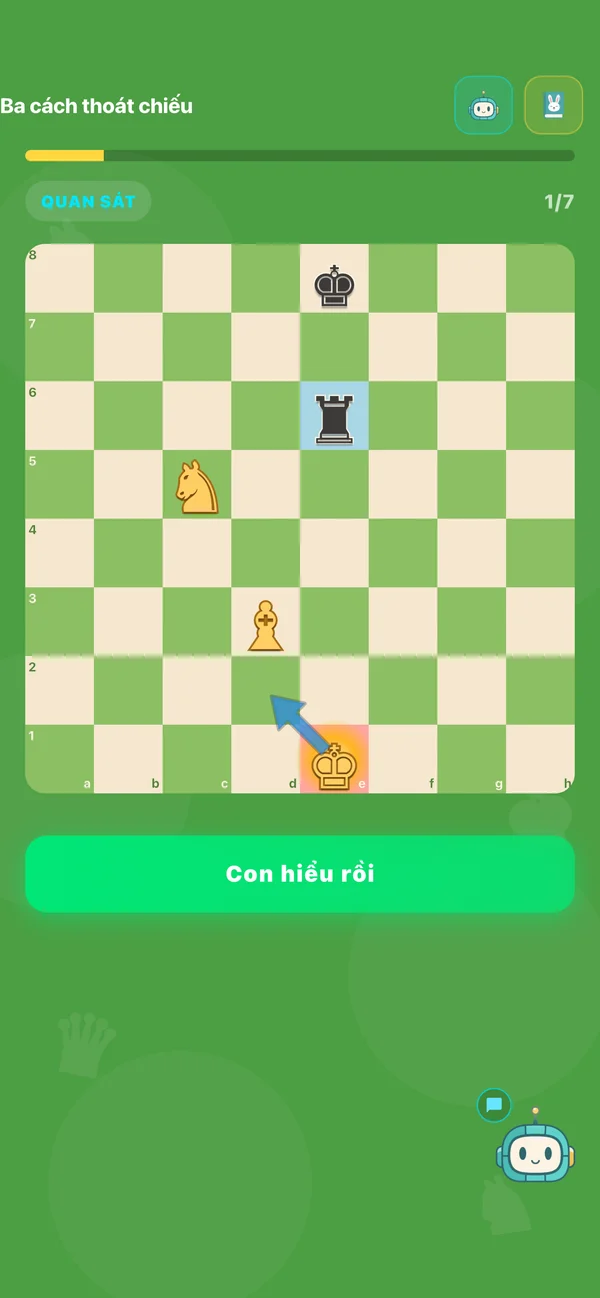
How many ways are there to escape the mat?
There are exactly 3 ways. Tips for your baby to remember: "Run, Block, Catch".
- Run: King moves to a cell that is not attacked. In the picture above, black King can move to d8, f8, d7 or f7 if those squares are safe, but cannot move to e7 because e7 is still on column e of Rook.
- Block: places one of his pieces between King and the check piece. This method can only be used with remote checkers (Rook, Bishop, Queen), cannot block Knight or Pawn.
- Capture: capture the check, with any piece that can be captured, including King if that cell is not protected.
Special case: double check is when two pieces check at the same time. At that time, it is impossible to block or catch both, so the only way is to let King run.
Teaching tip: every time the baby is exposed, the parents ask loudly three questions: "Can you run? Can you block? Can you catch?". After a few games, your baby will wonder in his head.
What is checkmate? The easiest example for children
checkmate is when King is hit and none of the 3 ways above can escape. The game ends immediately, checkmate side wins. This is the goal of the whole game. (A game also ends when one side loses, or time runs out if playing with a clock.)
The first checkmate pattern children should learn is checkmate last row:
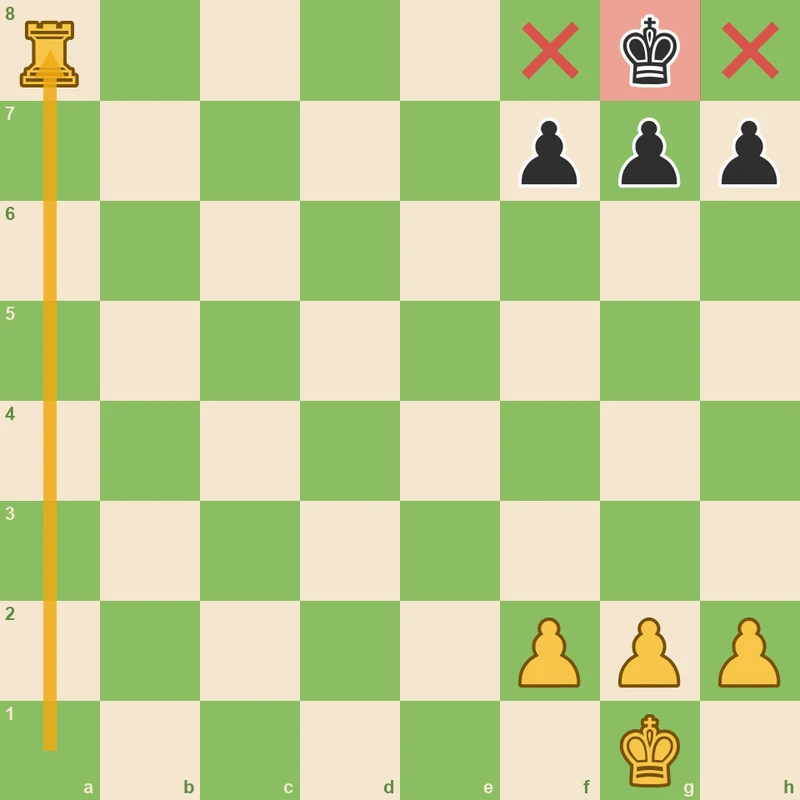
Let's check with your child by "Run, Block, Catch": Does King run f8 or h8? No, Rook still targets row 8. Run to row 7? No, my own Pawn stood there. Block? Black has no pieces placed between a8 and g8. Catch Rook? No army can reach a8. So checkmate.
Accompanying lesson for children: don't let King be locked by your own Pawn. When you have time, push a Pawn (eg h7 to h6) so that King has an "escape". If you want to practice more, see the exercises with answers in the lesson practice chess every day.
What is castling? When to get castling?
castling is the only special move where a player can play two pieces at the same time: King and a Rook. The goal is to put King in a safe corner and bring Rook to the middle to operate.
How to go when castling
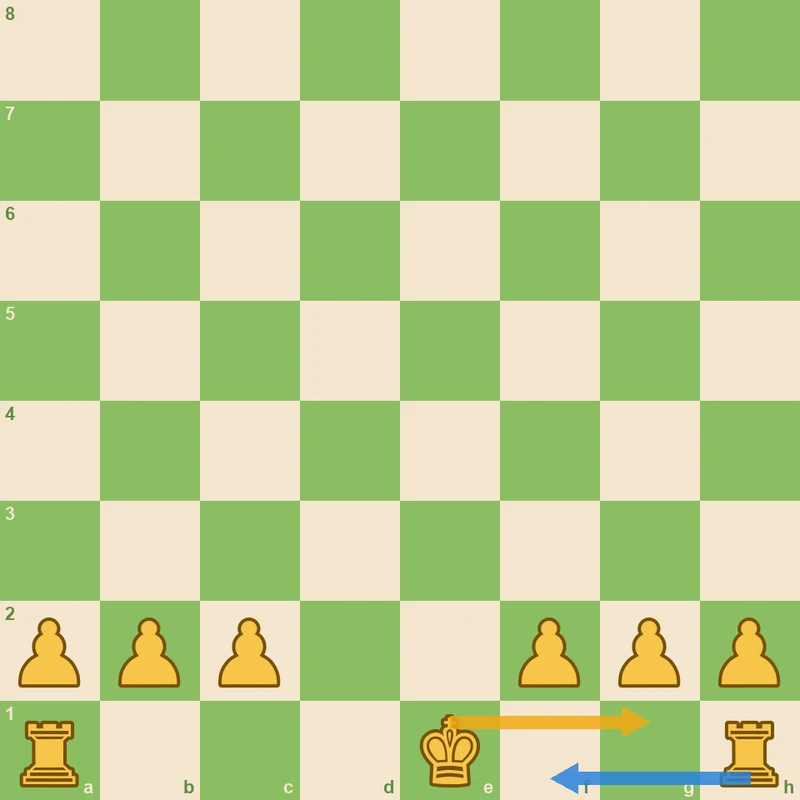
- castling takes off King (near): King goes 2 cells towards Rook h, from e1 to g1; Rook jumps over King, from h1 to f1. Black side is similar: King e8 to g8, Rook h8 to f8.
- castling wing Queen (far): King moves 2 spaces towards Rook a, from e1 to c1; Rook from a1 to d1. Black side: King e8 to c8, Rook a8 to d8.
According to FIDE rules, when castling must touch and go King first, then Rook. Teach your child this habit right from the beginning to avoid being caught making mistakes when taking the exam.
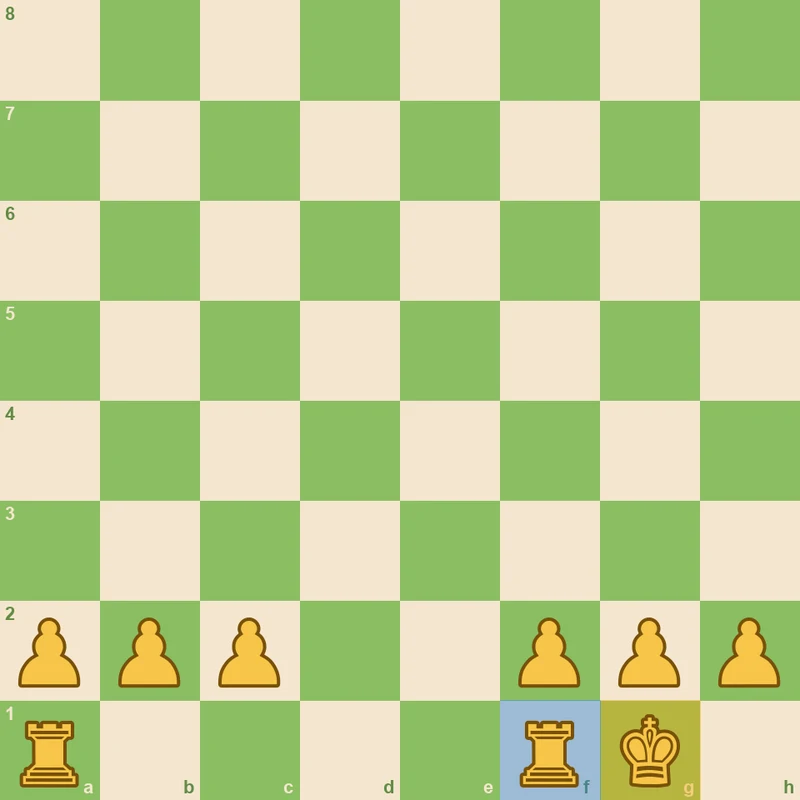
Condition castling (all 5)
- King hasn't made any moves since the beginning of the game.
- Rook is used to mean castling hasn't made any moves yet. If Rook h has already moved, it can still be castling with Rook a if Rook a hasn't gone yet.
- The cells between King and Rook are all empty. Wing King needs f1, g1 to be empty; Queen wing needs b1, c1, d1 to be empty.
- King is not in check. castling is not allowed to escape check.
- King does not pass through and does not go to the square attacked by the opponent attack. Wing King: f1 and g1 must be safe; wing Queen: d1 and c1 must be safe. As for box b1, when castling wing Queen only needs to be empty, it's okay to be attacked, because King does not go through b1.
Note: if King has been checked before but escaped by blocking or capturing (King does not move), then King will still be in check in the future. castling is okay.
Teaching tip: package the 5 conditions into the story "King and Rook haven't gone anywhere, the middle lane is empty, King is not being attacked, and has not stepped into danger". Let your child try castling in a few chess positions that the parents can arrange themselves, some of them work and some of them don't, let the child explain why.
What is promotion? What piece does Pawn become?
When a Pawn reaches the last row (row 8 with white Pawn, row 1 with black Pawn), it forces promotion: Pawn is immediately replaced by Queen, Rook, Bishop or Knight of the same color, chosen by the player. Changing pieces is part of the move itself.
- Cannot remain as Pawn, and cannot become King.
- That piece can be selected even if the same piece is still on the board. So a side can have 2 or more Queen.
- Almost always choose Queen because it is the strongest piece. Sometimes choosing Knight is more beneficial, for example when Knight can immediately predict King, or when choosing Queen it will cause stalemate.
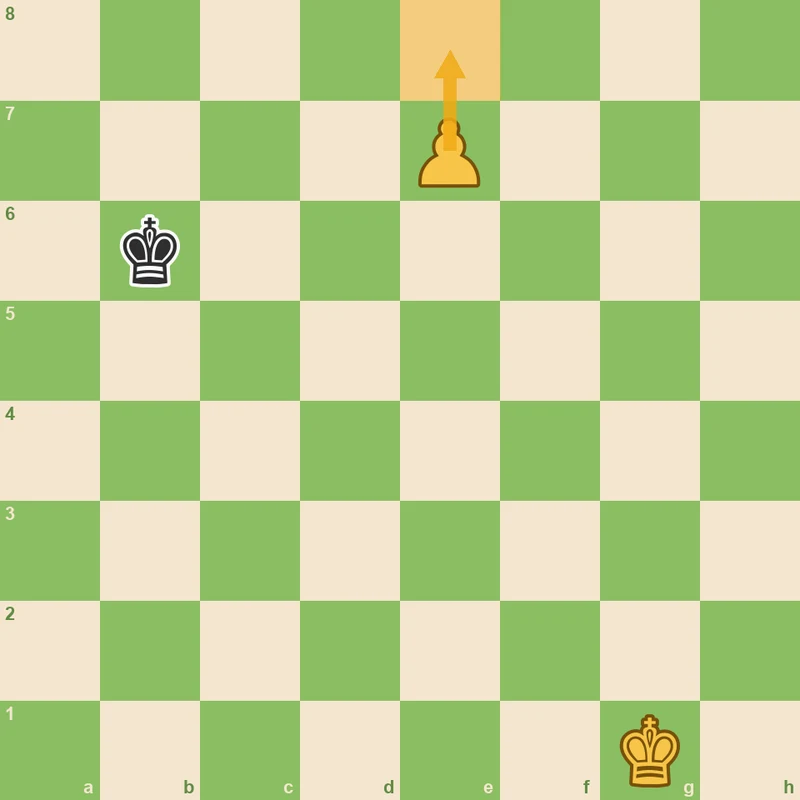
Teaching tip: game "Only Pawn plays Pawn" (8 Pawn on each side, whoever promotion first wins) is the most fun way for your baby to understand that the little Pawn is also valuable. Older children can continue playing after promotion to see how important Queen is.
What is en passant?
This is the strangest rule, many adults who have played for a long time still don't know. The rules are as follows:
- Your Pawn is standing in the 5th row from your side (row 5 with white Pawn, row 4 with black Pawn).
- An opponent's Pawn is in the next column go 2 spaces from the starting position and stop right next to your Pawn.
- You get to take that Pawn as if it only went 1 space: your Pawn goes diagonally into the space that the opponent's Pawn just "jumped over", and the opponent's Pawn is lifted off the table.
- This right is only available on next move. If you move to another move, the right to en passant with that Pawn is lost.
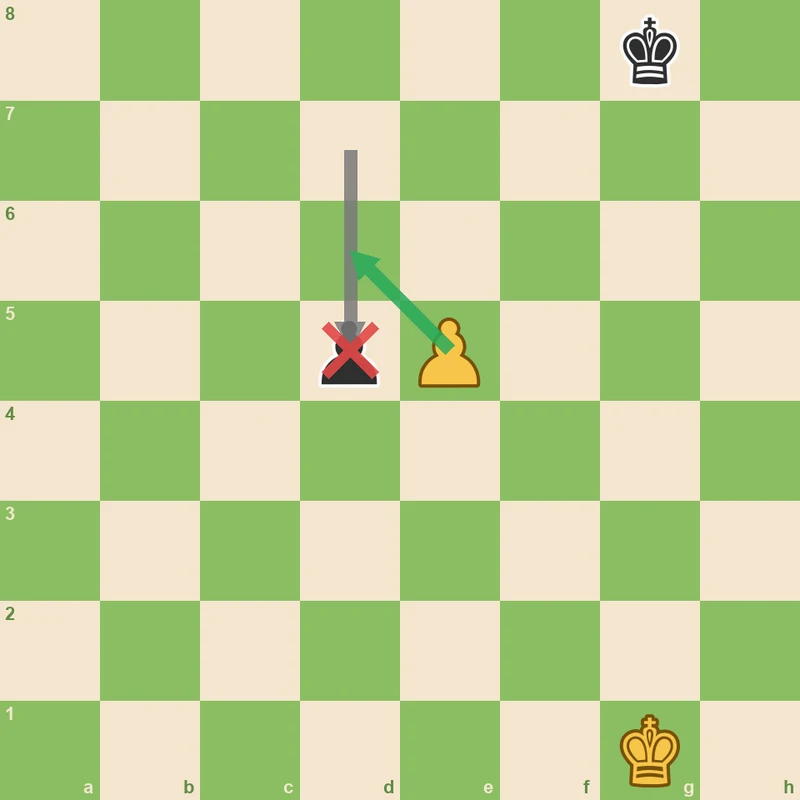
Teaching tip: explain with pictures "Black Pawn tried to sneak 2 steps past him, but White Pawn can still be caught if you react immediately." Only teach this rule when your child has mastered playing Pawn, because children can easily get confused if they learn it too early.
When is a chess game drawn?
Not every game has a winner. According to FIDE rules, draw cases include:
stalemate
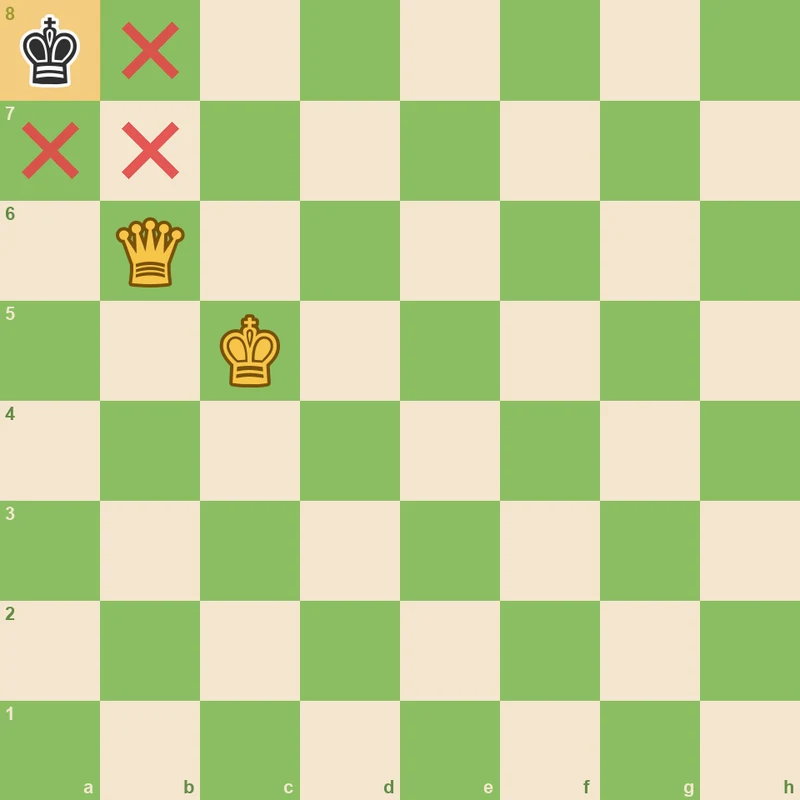
The side whose turn it is to go is not in check but has no more legal moves Which. The game was drawn immediately. This is the "trap" that causes many players who are winning big to draw, because they are so busy taking pieces that they forget to leave room for the opponent's King.
Repeat the chess position 3 times
The same chess position appears 3 times (same side's turn, same possibilities), the player has the right to ask the referee for a draw. If repeated 5 times, the game will automatically draw.
50-move rule
If in 50 consecutive moves of each side, no Pawn moves and no piece is captured, the player has the right to request a draw. At 75 moves, there is an automatic draw.
Not enough pieces to checkmate
When neither side can checkmate with any sequence of legal moves, the game is drawn immediately. For example: there is only King against King, King and one Bishop against King, King and one Knight against King.
Both parties agree
One party proposed a draw, the other side agreed. In tournaments for children, sometimes there are separate rules about recommending a tie, so parents should read the tournament regulations.
Teaching tip: when your child has more pieces, remind him "Before going, look at King, do you have any spaces left to go?". Let your child rearrange the stalemate position above and then find another move of Queen to avoid a draw.
Learn special rules in the Karotto app
Transparency note: Karotto is an application created by the team itself created by this blogging team. The section below describes exactly what the app has for parents to consider.
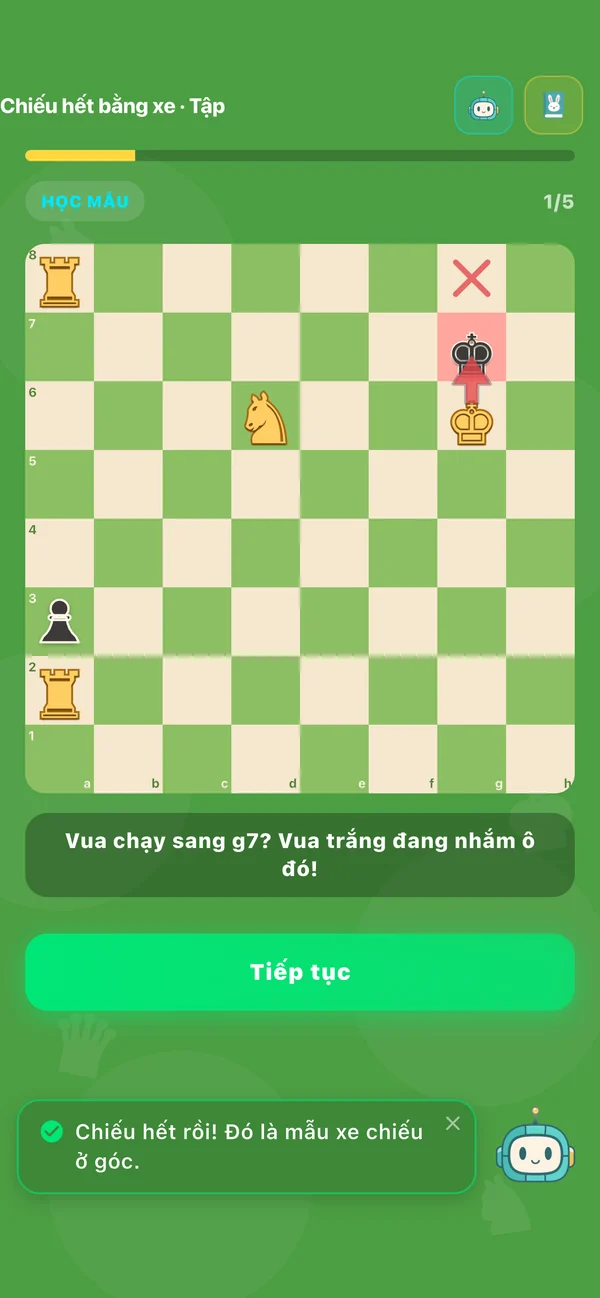
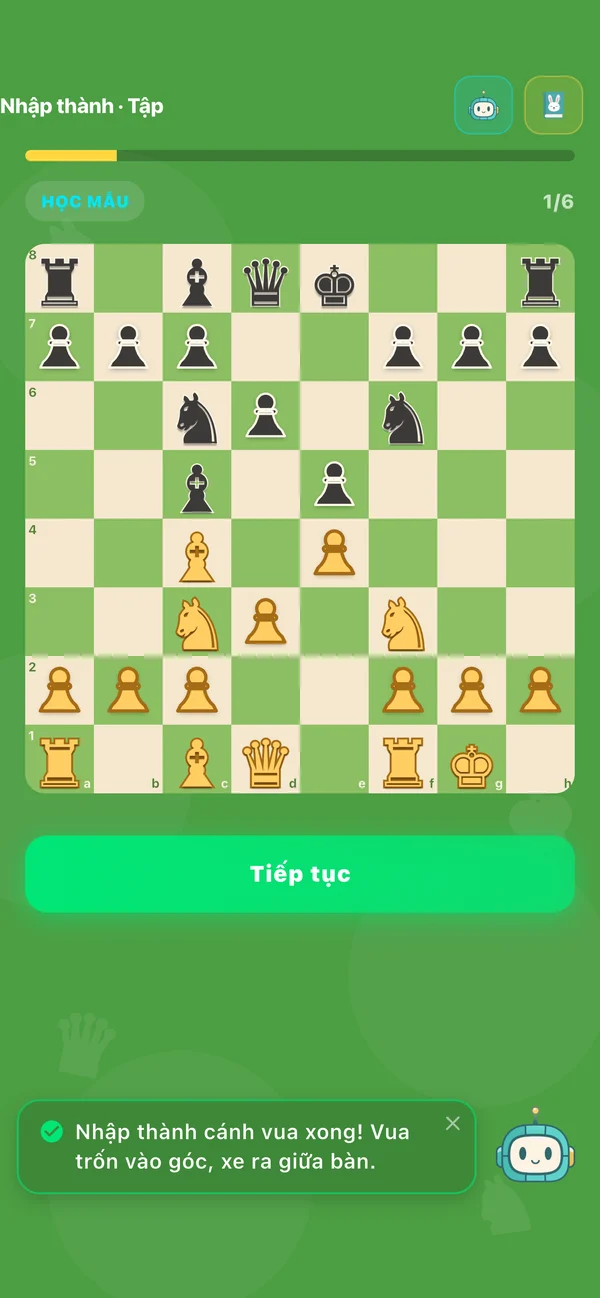
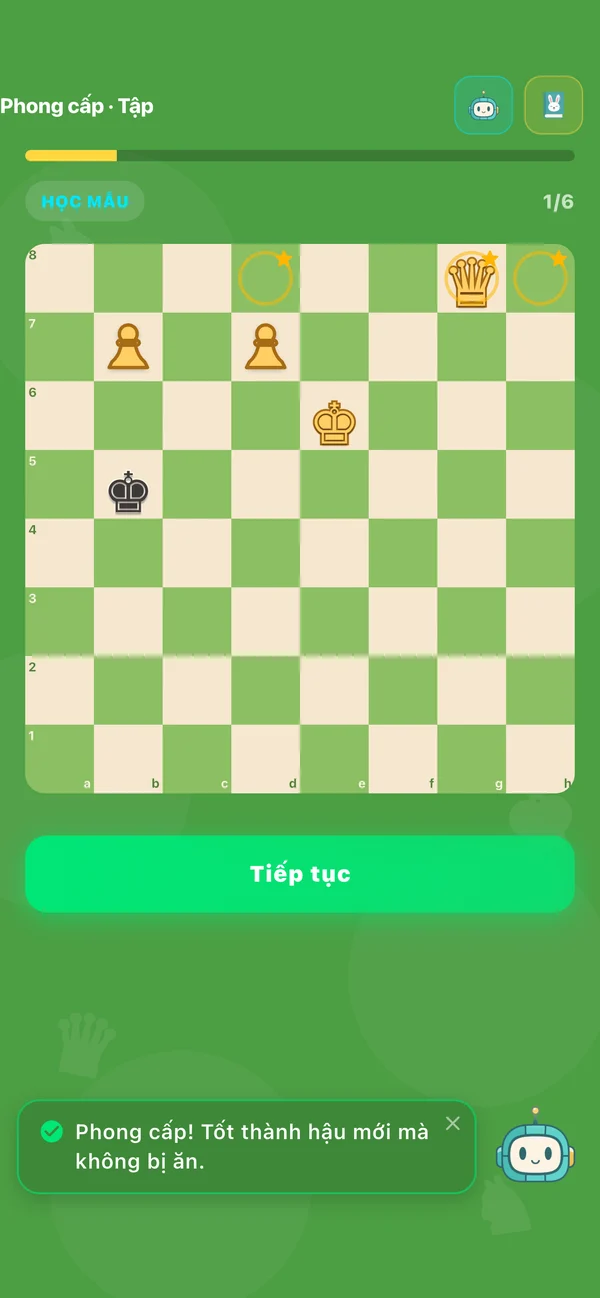
In Step 1 of the Chess course, each rule above has a "Know" lesson for the child to see how the rule works, then a "Practice" lesson for the child to move on their own: escape mat, checkmate, castling, promotion, en passant, stalemate. Instructions are read out loud, it's in Vietnamese, so children who can't read well can still follow along.
When the child makes a wrong move, the board replays the consequences, for example "King runs to g7? White King is aiming for the square there!", so that the child understands why it is wrong. When you make the right move, the chessboard also shows why that move is good. If the child is stuck, the robot suggests each step.
If parents want to see the whole route from Step 1 to Step 6, read the article children learn chess at home, or compare with other options in article chess learning app for children.
Frequently Asked Questions
Yes castling when King is being shown?
No. King is currently in check and must escape in another way. King also cannot be castling if the King cell passes through or the incoming King cell is under attack by enemy troops.
Is Pawn promotion required to become Queen?
Not required. The player can choose Queen, Rook, Bishop or Knight of the same color, even if that piece is still on the table. Pawn cannot remain Pawn and cannot become King.
stalemate is different from checkmate?
checkmate is King that is in check and cannot escape, that side loses. stalemate is King not in check but the side whose turn it is has no legal moves left, the game is drawn.
Is en passant required?
Not required, unless it is the only legal move. But if you want to catch it, you have to catch it in the next country; To pass a move is to lose the right.
When should the child learn the special rules?
After the child moves all 6 types of pieces correctly and understands the check, checkmate. You should learn one rule each session: castling first, then promotion, finally en passant and stalemate.
In short
If you are checked, "Run, Block, Catch"; can't escape is checkmate. castling needs to meet all 5 conditions, promotion chooses Queen, Rook, Bishop or Knight, en passant is only available in the following country. And when you're winning, remember to leave room for the opponent King to avoid being hit by stalemate.
Let your child practice each rule with Thỏ Bông
Karotto's Chess course has 283 lessons through 6 Steps, Vietnamese voice and no advertising. Every day your child learns a reasonable amount of lessons for free; Premium unlimited learning package is a one-time purchase for lifetime use, with no recurring deductions.
Download on App Store → Get on Google Play →